back to index
Proposing A Method of Taino Language Reconstruction Using Comparative Analysis of Cognates, And Preliminary Findings Using This Method
9 languages die worldwide every year; that’s a rate of 1 every 40 days, and this figure is only accelerating (Simons). To understand why this is happening, one must look at history and how majority languages spread. In 1492, Christopher Columbus landed on an island in what in English is now called the Caribbean. He described the people there, called the Taino, as among the nicest he had ever encountered; he described their language as smooth and sweet, and their people as gentle. In 1556, less than 70 years later, these people were declared extinct by the government that perpetrated their genocide (Estevez, “Conoce…”). While so much of the Taino language has been lost due of this, the reconstruction of the classical Taino language is feasible and important because the Taino people have not gone completely extinct, comparative linguistics can provide means of filling lexical gaps and give insight into grammatical structures, and lots of place names contain lexical information that can be used as guidelines for reconstruction.
Christopher had very good things to say about the people he met, saying that there was ”not a better country nor a better people in the world than these”. He describes that “They traded with us and gave us everything they had, with good will... they took great delight in pleasing us”. He also said “they are very well fitted to be governed and set to work to till the land, and do whatever is necessary”. Indeed, Columbus did just that, establishing his own colony and enslaving natives by the shipload over the subsequent decades (“Spanish…”). Columbus’ mistreatment of natives using forced labour and brutal punishments was critiqued even by his contemporaries. Spanish bishop Bartholome De Las Casas, who also happened to archive Columbus’ diary after joining one of his expeditions, was one of the earliest advocates for the abolition of slavery, and was highly critical of the actions of the Spanish in the new world and the slave trade in general, saying “What we committed in the Indies stands out among the most unpardonable offenses ever committed against God and mankind, and this trade as one of the most unjust, evil, and cruel among them”. Later, in the year 1500, as a colonial governor, Columbus was arrested, stripped of his titles, and taken back to Spain for his cruel treatment of the colonists he was charged with governing (Klein).
Although declared extinct on paper, the Taino people passed on their genes through unions with their spanish conquerors. Speculation that the Taino were not fully wiped out has existed since their extinction was declared, but was not proven until 2018 when genetic evidence came to light in the form of an intact tooth belonging to a Taino was discovered. This enabled scientists to compare mitochondrial DNA in the tooth to that of people still alive today, mostly those living in the Caribbean around Puerto Rico and Hispaniola. The findings were that the average person in Puerto Rico has as high as 14% Taino DNA, with some having much higher (Fernandes).
Their language lay hidden aswell in the Puerto Rican culture and dialect of Spanish, in which some loanwords and expressions have survived. Despite the widespread cultural impact that the Taino have had on this area centuries later, less than 10 sentences of Taino were ever recorded by the Spanish conquerors when they arrived in the region. The Taino had no written language and the Spanish who declared them dead did not put much work into archiving their language (Reyes). But, hope remains to fill the gaps in our knowledge of Taino grammar and lexicon by means of comparative linguistic analysis.
Comparative analysis is a method of language reconstruction by using cognates from related languages.Cognates are words in two or more different languages that evolved from the same source. These cognates are then compared to words in the subject language, and the sound changes that occurred, in order to accurately deduce what sound changes would have occurred in the language being reconstructed. Usage of this method would allow us to judge results from previous reconstruction attempts as to their authenticity, and fill previously impossible lexical gaps (Dunn). This is especially true for verbs, as up to 95 percent of surviving Taino words are nouns (Estevez, “Waking…”). This is because as the Spanish conquered, they only adopted words for things they did not already have words for, and rarely words that they already used in day to day life (Dunn).
The Taino language is typically catagorized in the Ta-Mapurian branch of the Arawakan language family. The exact languages composing the Arawakan language family are still disputed, but many suspect it had its origins as a trade language throughout the Carribean, which overtime began to suplant local languages, which would influence it’s evolution in different areas (Matteson). Other languages in the Ta-Mapurian branch are other languages suspected to be closely related, or quite likely descended from the same source language. The surviving language most closely related to Taino is the Lokono language, researchers estimate that around 1,500 people still speak Lokono today, although the language is not very well documented at this time (Pet).
In the Caribbean, especially Puerto Rico, a common last name is “Nanichi”, also written as “D’Nanichi”. Colloquial knowledge passed down for many generations tells us that this translates to “My Love” in English (“Planetary…”). In order to verify this claim, comparative linguistic techniques can be applied. An easy way to find cognates for this in related languages is to look for that language's word for love. For example, the word for ‘love’ in Lokono, which is a very closely related Arawakan language, is ‘anshishi” (Pet). The “D” part of the word seems to be absent in these cognates, this makes sense, as this D prefix is one of the only attested morphological elements. Also, interestingly, most of these words do not include that initial N seen in “Nanichi”. A reason for this could be that the N is actually a nominalizing prefix, differentiating the verb ‘to love’ from the noun ‘love’. This conclusion is supported by morphological analysis done by Julian Granberry and Gary Vescilius, who list a prefix “n” as a potential nominalizing prefix. This prefix works to differentiate “D[a]’nichi”, which could mean ‘I love’, this type of affixation of pronoun to verb is attested in surviving lines of Taino dialogue from “D[a]’nanichi”, which could mean “My love”.
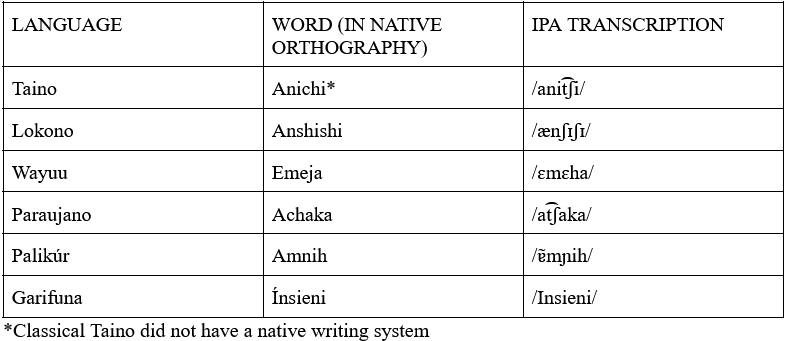
These words have gone through many sound changes in their individual languages. Despite this, one may observe their similarities, such as an onset vowel followed by a nasal consonant, the prevalence of voiceless postalveolar sounds, and a vowel at the end of the word. One can then reasonably conclude that, barring the possibility of false cognates, these words from separate Arawakan languages are all descended from the same Proto-Arawkan language, or perhaps an even more closely related proto-language. This comparative analysis has yielded information about pronoun affixation, a potential nominalizing affix, and the Taino word for ‘to love’. This method can be applied many more times over to not only verify the validity of some speculative translations, but also to find words to fill lexical gaps by applying these same methods but without the support of the surviving word. Love is a very significant concept in most cultures worldwide, and so the ability to express love to someone or something is quite a powerful one.
Bibliography
Blust, Robert. "Let's talk about trees: Genetic relationships of languages and their phylogenetic representation." Journal of Southeast Asian Studies, vol. 50, no. 3, Sept. 2019, pp. 450+. Gale In Context: High School, dx.doi.org/10.1017/S0022463419000389. Accessed 14 Jan. 2025
Columbus, Christopher, et al. Personal narrative of the first voyage of Columbus to America: from a manuscript recently discovered in Spain. Boston: Published by T.B. Wait and Son, and sold by Wait, Greene and Co., Boston, and C. Arvill, New-York, and Carey and Lea, Philadelphia, 1827. Pdf. Retrieved from the Library of Congress, www.loc.gov/item/02008207/.
Dunn, Michael, et al. "Structural phylogenetics and the reconstruction of ancient language history." Science, vol. 309, no. 5743, 23 Sept. 2005, pp. 2072+. Gale In Context: High School, link.gale.com/apps/doc/A137350125/SUIC?u=vanc63311&sid=bookmark-SUIC&xid=cb7a0c0c.
Deagan, Kathleen. "Reconsidering Taino social dynamics after Spanish conquest: gender and class in culture contact studies." American Antiquity, vol. 69, no. 4, Oct. 2004, pp. 597+. Gale In Context: High School, link.gale.com/apps/doc/A124862975/SUIC?u=vanc63311&sid=bookmark-SUIC&xid=abdac2d2.
Estevez, Jorge B. “Waking a Language From Its Slumber | NMAI Magazine.” NMAI Magazine, www.americanindianmagazine.org/waking-the-taino-language.
Estevez, Jorge B. “Origins of the word Taino.” 2016. https://www.researchgate.net/publication/296694496_Origins_of_the_word_Taino
Estevez, Jorge B. “Conoce a Los Supervivientes de Un “Genocidio Sobre El Papel.” National Geographic, 15 Oct. 2019, www.nationalgeographic.es/historia/2019/10/los-supervivientes-tainos-de-un-genocidio-sobre-el-papel.
Fisk, Jonathan. “Naming multiplicity: Taíno ecolinguistics and naming conventions, and implications for language reclamation and decolonizing environmental relationalities”. Language Sciences, Vol 108, 2025, 101693, https://doi.org/10.1016/j.langsci.2024.101693.’
Fernandes, Daniel M, Kendra Sirak, et al. “A Genetic History of the Pre-Contact Caribbean.” Nature, vol. 590, no. 7844, 23 Dec. 2020, pp. 103–110, https://doi.org/10.1038/s41586-020-03053-2.
Granberry, Julian & Vescelius, Gary. (2009). Languages of the Pre-Columbian Antilles. Bibliovault OAI Repository, the University of Chicago Press.
Jackson, Nathan E. Waltz & Diana R. Christian (eds.). Comparative studies in Amerindian languages , pp. 160-242. The Hague: Mouton.
Klein, Christopher. “10 Things You May Not Know about Christopher Columbus.” HISTORY, Sept. 2018, www.history.com/news/10-things-you-may-not-know-about-christopher-columbus.
Matteson, Esther. 1972. Proto Arawakan.
Pet, Willem J. A. and SIL International. “A Grammar Sketch and Lexicon of Arawak (Lokono Dian).” SIL e-Books, by George Huttar et al., vol. 30, 2011, www.sil.org/system/files/reapdata/90/56/45/90564558109971050115741497077250122669/e_Books_30_Pet_Arawak_Suriname.pdf.
Planetary Names. planetarynames.wr.usgs.gov/Feature/4140.
Reyes, David. "The Origin and Survival of the Taíno Language". 2004. Issues in Caribbean Amerindian Studies. 5 (2).
Simons, Gary F. “Two Centuries of Spreading Language Loss”. Proceedings of the Linguistic Society of America, vol. 4, no. 1, Mar. 2019, pp. 27:1–12, https://doi.org/10.3765/plsa.v4i1.4532.
“Spanish Settlers Enslave the Taíno of Hispaniola - Timeline - Native Voices.” Www.nlm.nih.gov, www.nlm.nih.gov/nativevoices/timeline/170.html.
Schroeder, Hannes and Martin Sikora, et al. “Origins and Genetic Legacies of the Caribbean Taino.” Proceedings of the National Academy of Sciences, vol. 115, no. 10, 20 Feb. 2018, pp. 2341–2346, www.pnas.org/content/pnas/115/10/2341.full.pdf, https://doi.org/10.1073/pnas.1716839115.
Thomas, Piri, and Suzie Dod. "Puerto Rico - 500 years of oppression." Social Justice, vol. 19, no. 2, summer 1992, pp. 73+. Gale In Context: High School, link.gale.com/apps/doc/A13850066/SUIC?u=vanc63311&sid=bookmark-SUIC&xid=9150815a.